Interior
How to choose a cat tree that suits a modern interior: natural materials, calm colours, clean lines and a place by the window, without giving up anything your cat needs.
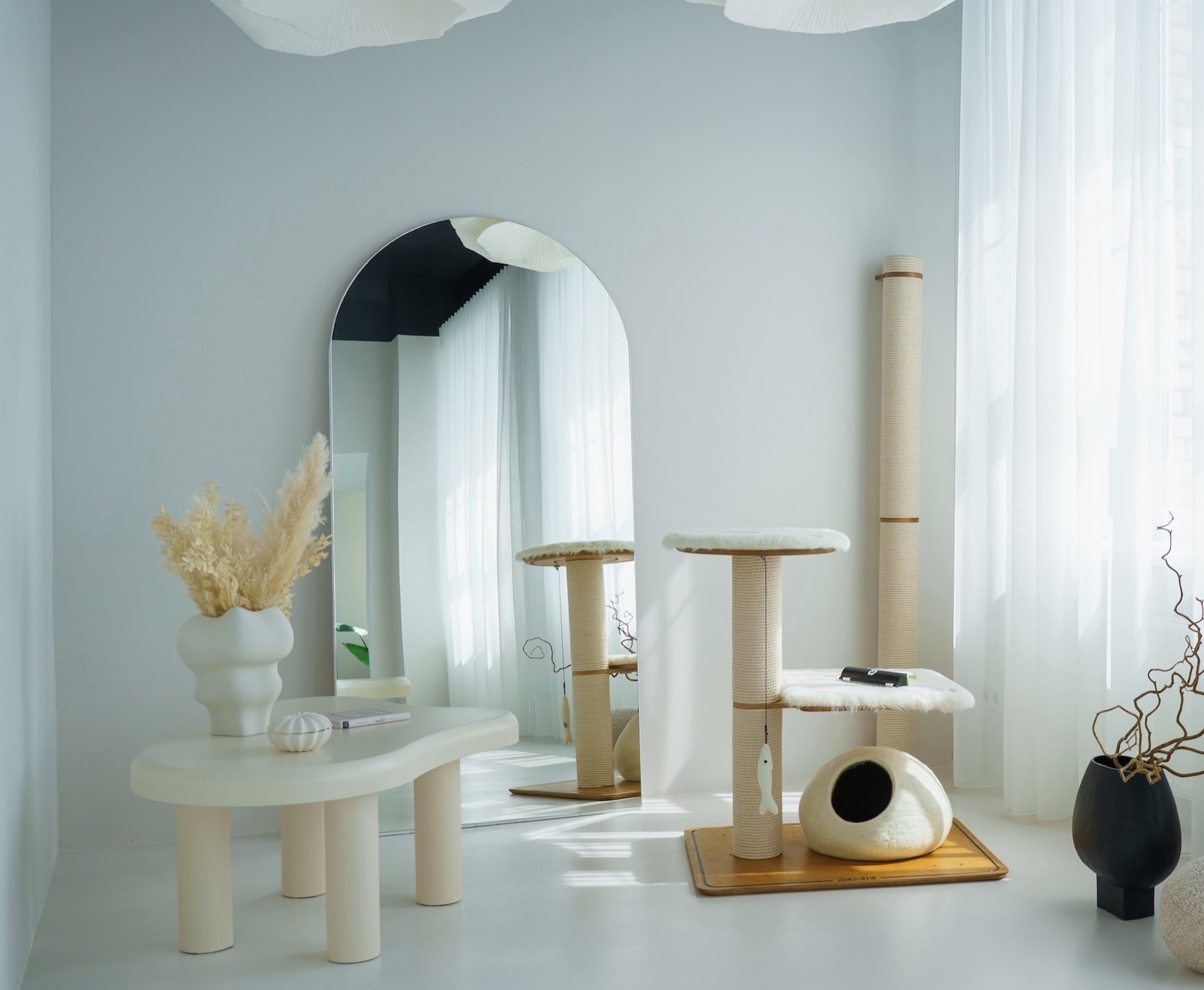
Many cat owners end up hiding the cat tree in a corner, because the usual beige carpet tower does not belong next to good furniture. It does not have to be that way. A cat tree can be a piece of furniture in its own right, and cats are happiest when their tree stands in the middle of family life, not behind a door.
This guide covers the choices that make a cat tree sit well in a modern interior: materials, colour, shape, size and placement. None of it asks you to compromise on what your cat needs. In most cases, the tree that looks best in the room is also the one your cat will use most.
Natural materials age well and sit comfortably next to a wooden floor, a linen sofa or a concrete wall. Kikska trees use solid plywood and solid wood finished with organic wood oil, so the grain stays visible, with natural cotton or sisal rope and soft faux fur. Nothing is covered in carpet, and nothing is hollow.
Carpet-covered trees tend to look worn quickly: the fabric holds hair, flattens where the cat sleeps and frays where it scratches. Exposed wood with an oiled finish behaves more like a dining table or a shelf. It picks up a little character with use, and a wipe with a cloth keeps it clean. The visible plywood edge, with its fine layers, is the kind of detail you see on contemporary furniture, and it fits the same rooms.

Treat the tree like any other piece of furniture and match it to the room:
Rope adds texture: cotton reads soft and pale, sisal slightly more rustic.
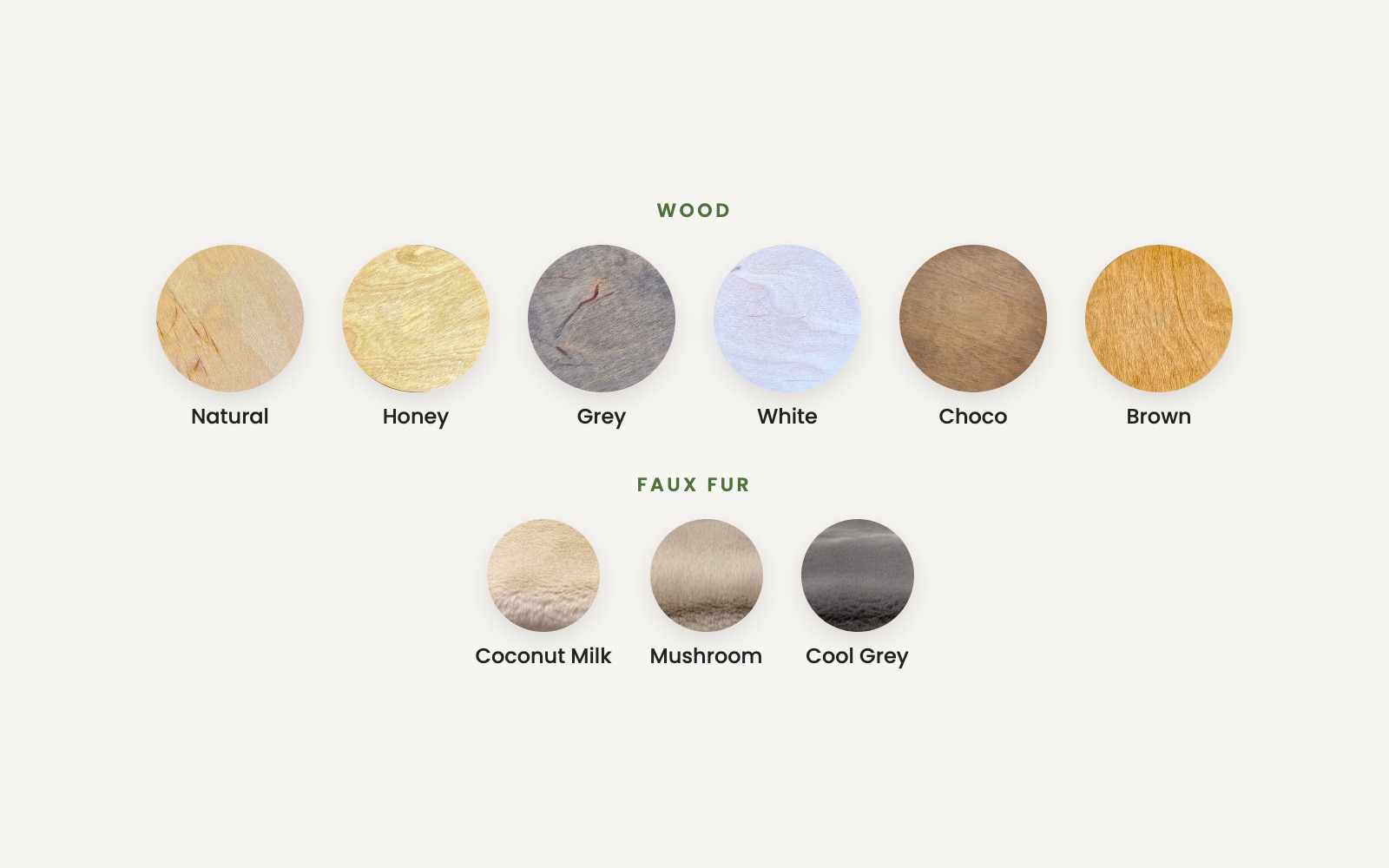
The simplest approach is to match the tree to the largest wooden surface near it. If the floor is pale oak, Natural wood sits naturally on it. If the room has walnut or dark-stained furniture, Choco or Brown keeps the tree in the same family. When the room has no wood at all, for example white walls and a grey sofa, White or Grey wood lets the tree blend in rather than stand out.
Fur pads and wool caves are the softer elements, and they work like cushions and throws. Choose them to echo something already in the room: Coconut Milk next to cream textiles, Mushroom beside warm browns and linen, Cool Grey with charcoal or concrete. The wool caves come in Coconut Milk, Mushroom and Grey Stone, with a green lining. Keeping one fur colour across all platforms usually looks calmer than mixing several.
It also helps to think about your cat's coat. Pale fur shows less on Coconut Milk, darker coats on Cool Grey or Mushroom. That is practical rather than decorative, but it decides how often the tree looks tidy.

Visual calm comes from simple geometry. A few round or square platforms, straight posts and one material family look intentional. Our platforms come in two shapes, rounded or squared, both 44 cm across, so you can keep a tree strictly geometric or soften it with curves next to rounded furniture.
A few guidelines help a tree look designed rather than cluttered:
Kikska posts are 13 cm across in solid wood, in lengths of 20, 40 and 80 cm, so you can plan a tree in clear steps. If you are unsure how tall to go, our guide on choosing cat tree height helps you balance the room and the cat.
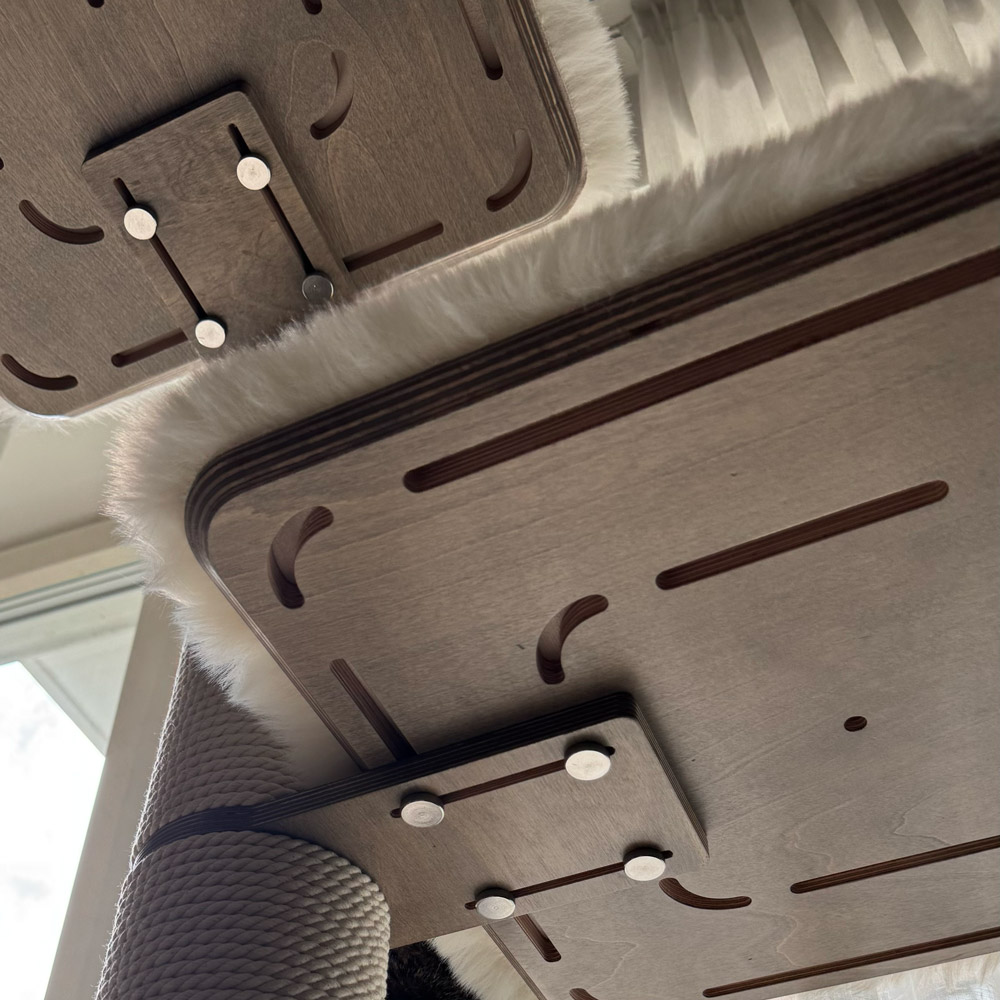
The best place for a cat tree is also the best place to show it off: by a window, with a view. Cats like to watch the street and the birds, and a tree in the light looks like a deliberate part of the room. Placed near the sofa, a tall post also gives your cat a better option than the armrest.


A modern tree should look proportionate. Kikska kits run from 84 cm to 215 cm tall. In a room with standard ceilings, a mid-height tree of around 130 cm often sits comfortably next to a sofa or sideboard, while a tall tree such as the 215 cm Adventurer's Atrium suits high ceilings and open-plan spaces. Small kits around 85 to 95 cm fit beside a desk or under a window. The configurator draws your tree to scale in a room with a height meter, so you can check proportions before ordering.
A wall-mounted scratching column such as Skyline Scratchers takes up no floor at all. Its colour-matched wooden mounts and hidden brackets make it look as if it floats on the wall, and it works well in hallways and small flats.
A hanging column is another option where the ceiling is solid concrete or has joists to fix into. Both wall and hanging setups keep the floor clear, which can make a small room feel larger. Our guides to cat trees for small apartments and standing, wall-mounted or hanging trees compare the options.
Design furniture should stay beautiful. Fur pads lift off to shake out or swap, and every part can be replaced on its own, so a worn post or a faded pad never spoils the whole piece. Change a fur colour when you redecorate, and the tree moves with you to the next home.
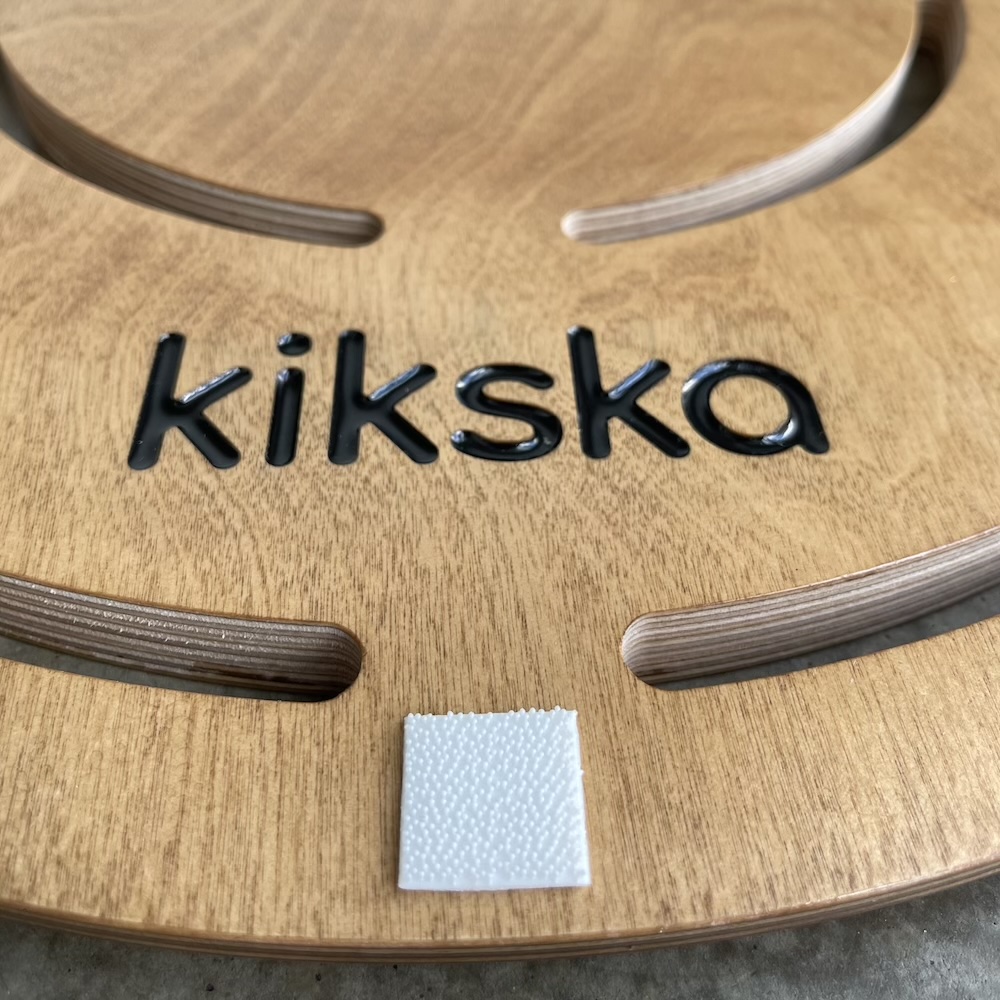
A short routine keeps a tree tidy: lift the fur pads off their Velcro and shake them out regularly, use a lint roller or the reusable pet hair remover on pads and caves, and wipe the wood with a dry or slightly damp cloth. When the rope on a favourite post is well scratched, replace that post rather than the tree. Our article on replaceable parts explains how.
It can, if it follows the same rules as the rest of the room: few materials, simple shapes and a clear place. Exposed oiled wood and a single fur colour help it read as furniture.
Either works. Matching the floor makes the tree recede; matching a nearby piece of furniture makes it look part of a set.
Fur pads can be swapped at any time, and platforms or posts can be replaced individually, so the tree can follow a new colour scheme.
Explore the full range of modern cat trees or design your own in the configurator.
Modular cat tree kits from 84 to 215 cm. Every part fits every other part, so the tree can grow with your cat.

Made in Europe from modular, replaceable parts. Add a level, swap a cushion, change the layout: the tree you buy today keeps working for years.
Worldwide delivery
Shipped with UPS, DHL and FedEx.
Money-back guarantee
Not right for your cat? You get your money back.
Secure checkout
Pay safely with Stripe, PayPal or Apple Pay.
Replaceable parts
Every part can be swapped or reordered.

Modular cat trees, made in Europe and delivered worldwide.