Guides
A floor-standing cat tree, a wall-mounted one or a scratching post that hangs from the ceiling: how they differ in space, stability, installation and price.
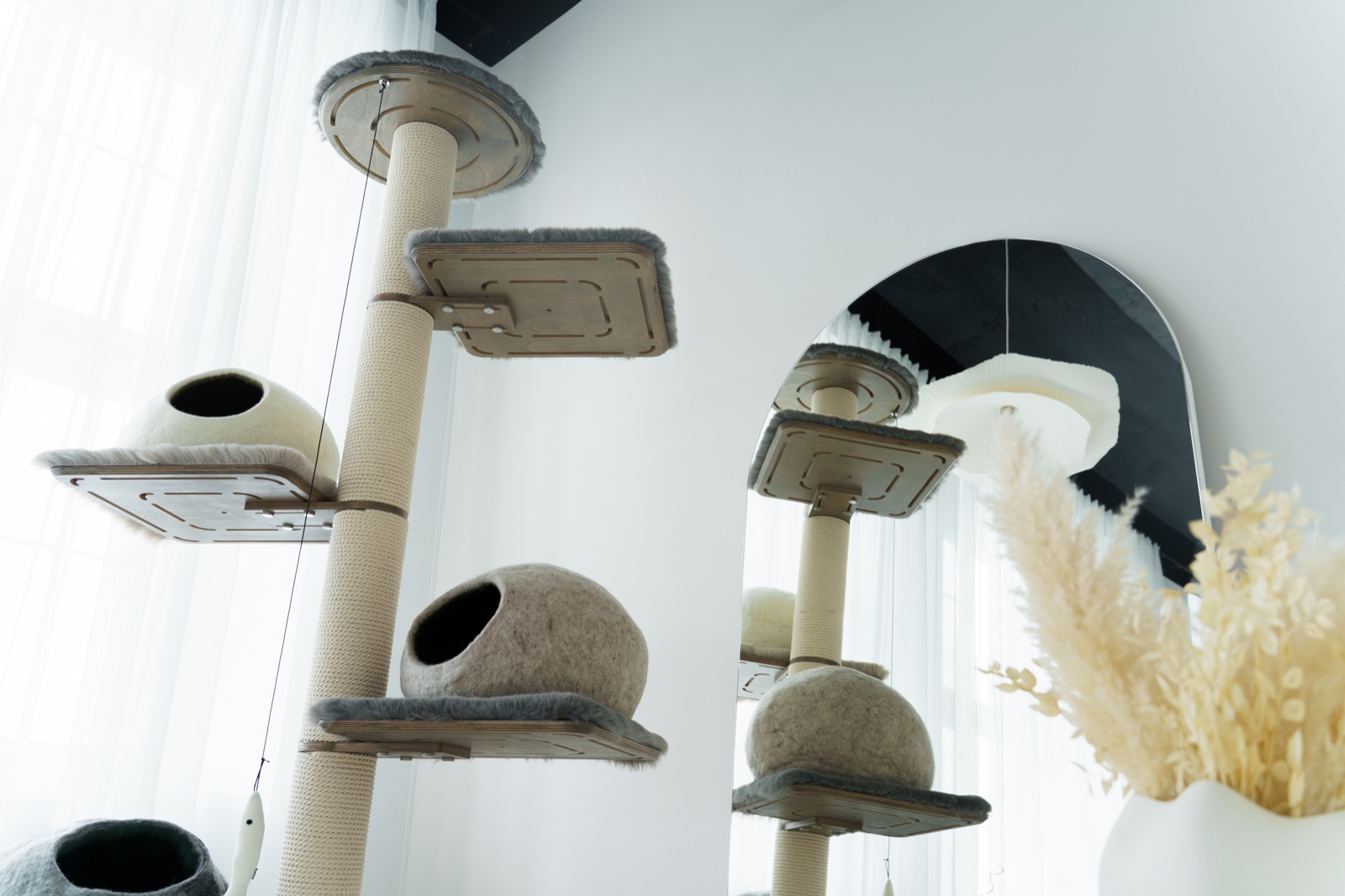
A cat tree used to mean one thing: a carpeted tower on a wide base. Today you can also fix one to the wall or hang a scratching post from the ceiling. Each type solves a different problem. Here is how they compare, so you can pick the one that suits your cat and your room.
Before you look at any product, it helps to answer three questions. What does your cat actually do most: scratch, climb, watch or sleep? How much free floor and wall space do you have, and where? And can you drill into your walls or ceiling? The answers usually point clearly to one type, or to a combination of two.
A standing tree rests on its own base, so it needs no drilling and you can move it whenever you rearrange the room. It is the only type that can carry several wide platforms, caves and toys at different heights, which makes it the best choice for climbers and multi-cat homes.
Kikska standing trees run from a compact 84 cm Mini Meow Tower to the 215 cm Adventurer's Atrium, all on solid 20 mm plywood bases.
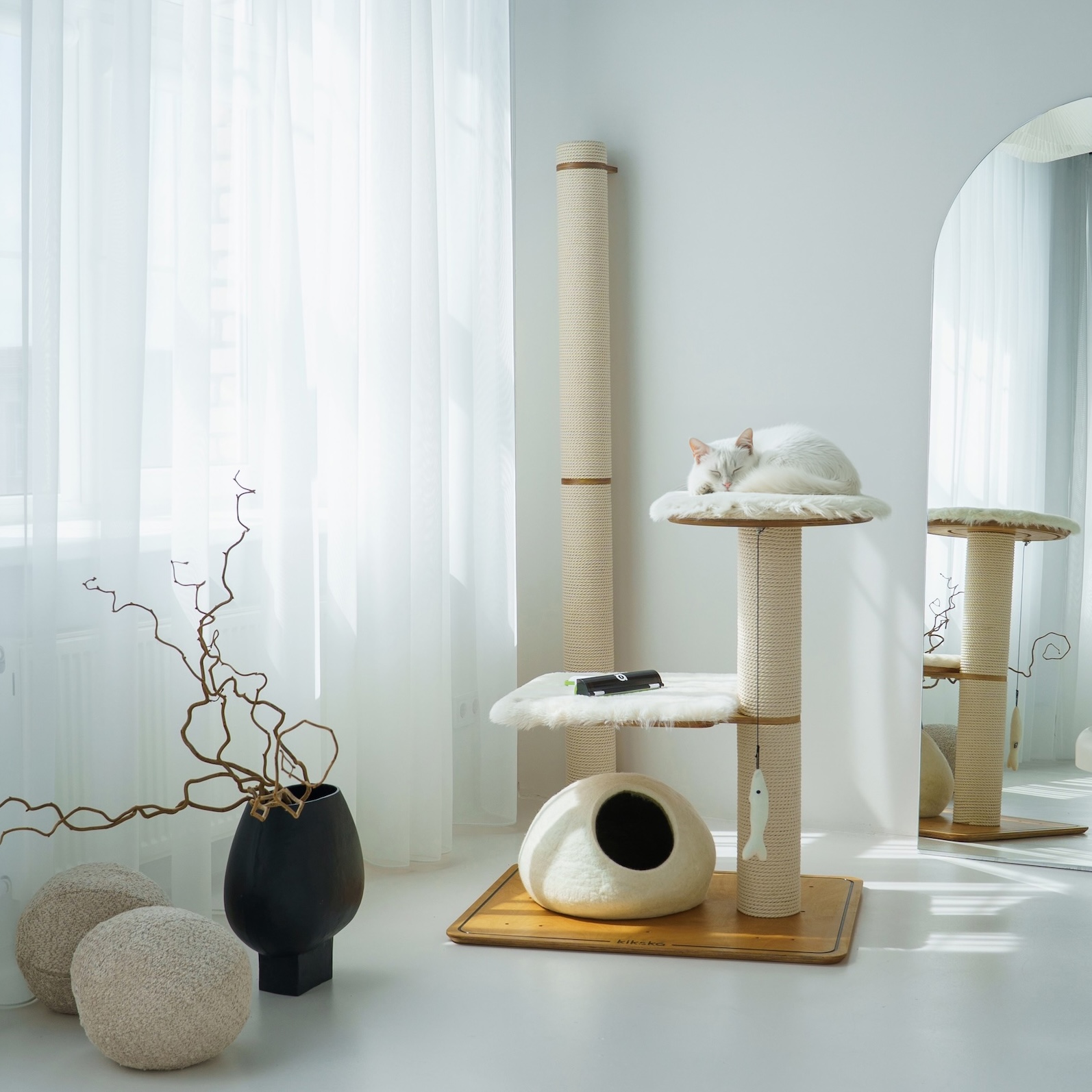
A standing tree depends entirely on its base. The taller the tree and the heavier the cat, the more the base has to resist the push of a cat landing on a top platform or jumping off it. Our bases are pre-drilled, solid plywood in four sizes: round 60 cm, and square 66 × 66, 80 × 66 and 80 × 80 cm. The 80 × 80 cm base weighs 9.2 kg on its own, which gives a tall tree a low, heavy anchor. As a rule, choose a wider base as the tree gets taller, and keep the heaviest platforms close to the post rather than far out to the side. Our guide to what makes a cat tree sturdy goes into this in more detail.
Standing trees are also the easiest to change. Posts in 20, 40 and 80 cm lengths join end to end, and platforms, caves and post caps can be added later, so a short tree for a kitten can grow into a tall one for an adult cat.
A wall-mounted tree is fixed to the wall at the top and bottom, so it cannot tip over and needs no floor space at all. It starts above the floor, so you can clean underneath, and it suits narrow spaces such as hallways or the gap beside a wardrobe.
Our Skyline Solo (95 cm) and Skyline Scratchers (190 cm) sit on plywood wall mounts with hidden stainless steel brackets. In the configurator you can build a full wall tree with up to three 80 cm posts and platforms that point out from the wall.

Each mount is a small plywood plate, 13 × 16.5 cm, with a hidden stainless steel bracket. You fix two screws with suitable plugs into the wall, then the mount slides onto the screws. The post is held at the top and the bottom, which is why it stays still under a strong scratch. In wall mode the configurator starts the tree about 20 cm above the floor, which leaves room for a vacuum cleaner underneath.
Solid brick and concrete walls take standard plugs well. Plasterboard and hollow partition walls need fixings made for them, or better still, screws into the timber or metal studs behind. If you are unsure what your wall is made of, ask a local hardware shop or a handyman before you drill. Our wall-mounted cat tree guide covers fixing in more detail.
A hanging post hangs on a steel cable from a single ceiling fixing. There is no base and nothing on the wall: just a column of rope at the height you choose, right where your cat already likes to scratch. It reads more like a piece of design than a cat accessory.
Choose Hanging Solo (90 cm) or Hanging Double (170 cm). Both come with a 3 m stainless steel cable and ceiling fixing.
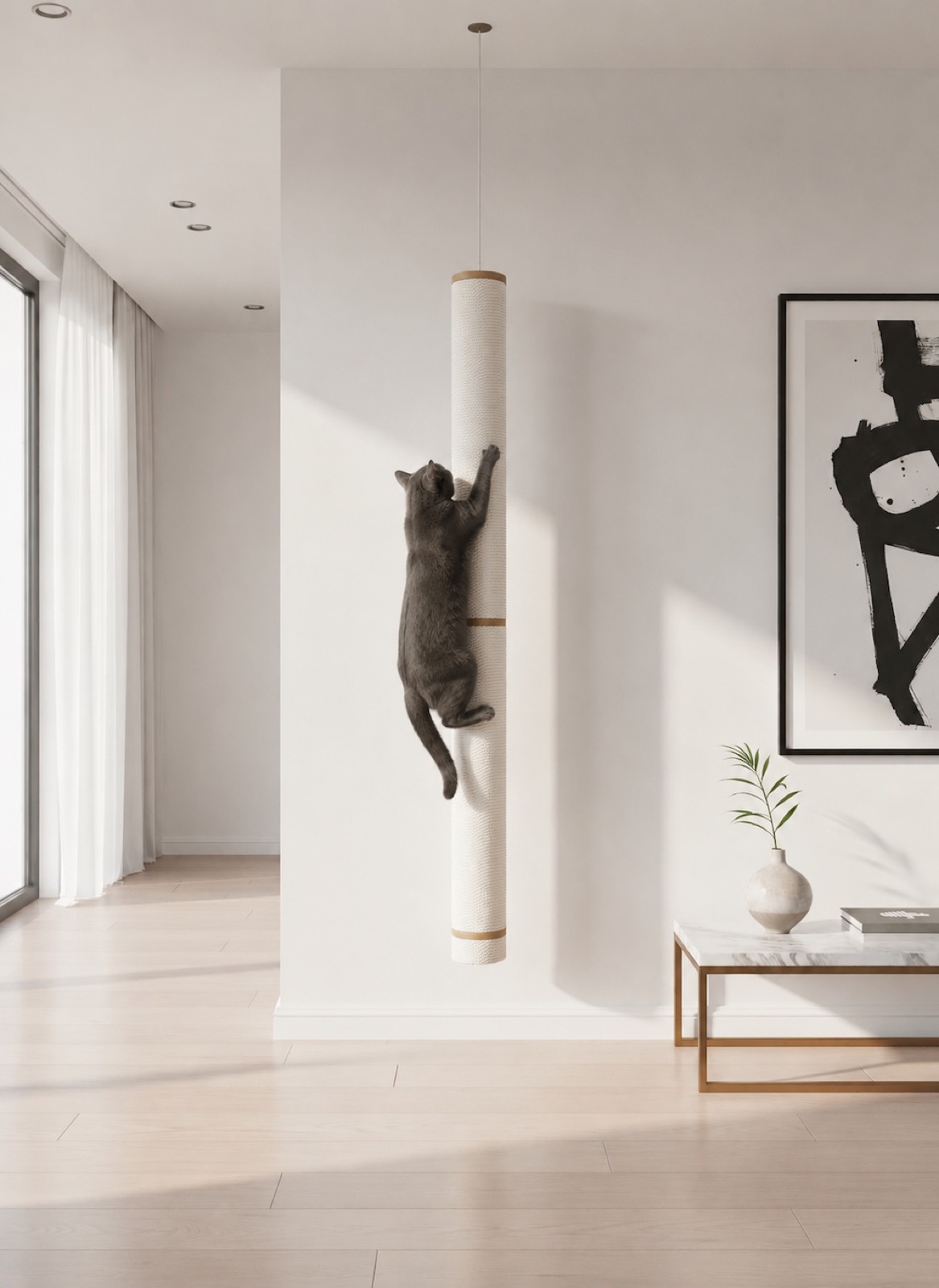
Because the cable gives a little, a hanging post moves slightly when your cat scratches it. A nervous cat may need a few days to trust it. Hang it so the bottom sits close to the floor, at the height where your cat reaches up to scratch, and place it in open space, away from shelves or furniture it could swing into. In the configurator's hanging mode you can build a hanging post up to 180 cm long and see it to scale before ordering. For fixing and placement tips, read the hanging scratching post guide.
Many homes work best with two: a standing tree by the window for naps and lookouts, and a wall-mounted or hanging post next to the sofa, where the scratching happens. Because every Kikska part fits every other, posts, platforms and caves can move between them as your cat and your home change. Read our guides to wall-mounted cat trees and hanging scratching posts.
In a small flat, a combination often takes less space than one large standing tree. A slim wall tree in the hallway and a hanging post in the living room spread scratching and climbing across the home without a footprint. Our guide to cat trees for small apartments has more layouts.
A standing tree needs no drilling, so it is the simplest choice if you cannot make holes. If small screw holes are acceptable, a wall-mounted or hanging post leaves only those holes when you take it down.
Yes. Wall trees can carry platforms that point out from the wall, and a 44 cm platform can hold a wool cave. Hanging posts, by contrast, are for scratching and climbing only.
It is held from above by a stainless steel cable, so it does not tip like a light standing post can. It does sway a little by design. The key is a solid ceiling fixing into concrete or a wooden joist.
Parts are interchangeable, so posts, platforms and caves from a standing tree can be reused on a wall tree and the other way round. You add the base, wall mounts or cable kit as needed from parts, wall mounts and hanging parts.
Every type is assembled with screws and a 6 mm Allen key. Wall and hanging versions also need a drill for the fixings. Step-by-step instructions are on our assembly page.
Modular cat tree kits from 84 to 215 cm. Every part fits every other part, so the tree can grow with your cat.

Made in Europe from modular, replaceable parts. Add a level, swap a cushion, change the layout: the tree you buy today keeps working for years.
Worldwide delivery
Shipped with UPS, DHL and FedEx.
Money-back guarantee
Not right for your cat? You get your money back.
Secure checkout
Pay safely with Stripe, PayPal or Apple Pay.
Replaceable parts
Every part can be swapped or reordered.

Modular cat trees, made in Europe and delivered worldwide.
.png)