Guides
How wall-mounted cat trees work, when they beat a standing tree, and how to fit one safely: wall types, height and the parts you need.

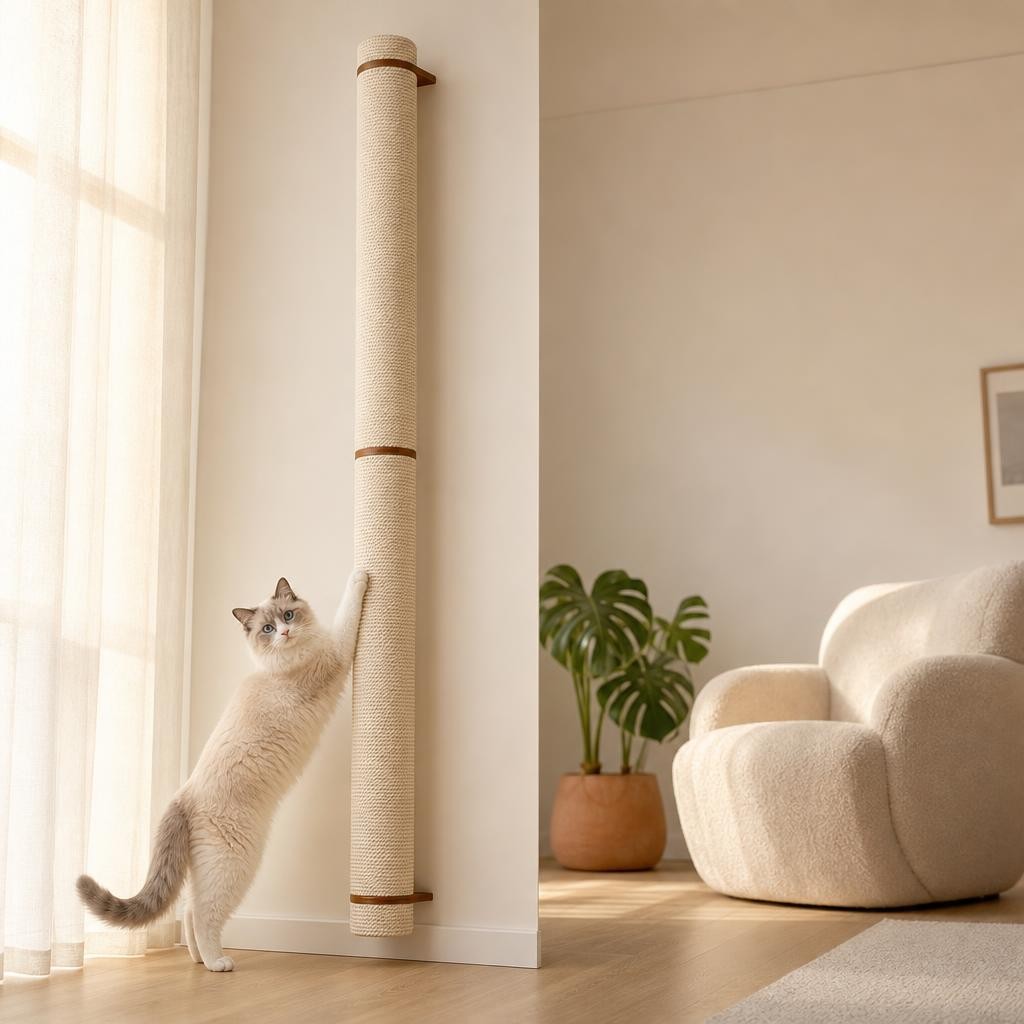
In a small flat every square metre counts. A wall-mounted cat tree gives your cat a full-height place to climb, scratch and stretch, while the floor underneath stays free for a sofa, a radiator or just a clean line. Here is how wall-mounted cat trees work, when they make sense, and how to fit one.
Instead of standing on a base, the column of scratching posts is fixed to the wall at the top and the bottom. Because it is held at both ends, it cannot tip over, and it stays steady even when a large cat hangs on it with its full weight. The tree starts above the floor, so you can clean underneath.
Kikska wall trees sit on plywood wall mounts with hidden stainless steel brackets. The mount is colour-matched to the posts, so all you see is the column, as if it floats on the wall.

Each wall mount is made of 15 mm plywood and measures 13 x 16.5 cm, so it is barely wider than the post it holds. The posts themselves are solid wood, 13 cm across, wrapped in sisal or cotton rope. That width matters: a cat needs a surface broad enough to dig into with both front paws for a proper, full-body stretch.
Each wall mount comes with two long steel screws and two wall plugs. The screws go into the wall, and the mount slides onto them, so nothing shows on the front:

A freestanding tree relies on the weight and width of its base to resist a cat leaping onto it. A wall tree does not need a heavy base, because the wall takes the load at two points. The result is a column that does not rock when a cat launches itself at it from across the room, which is exactly the moment a wobbly tree can put a cat off for good. For more on what keeps a cat tree steady, read what makes a cat tree sturdy.
If you rent and cannot drill, or you want several wide platforms and caves for more than one cat, a standing cat tree is usually the better fit.
Avoid walls directly above radiators and spots right next to the litter tray or food bowls. Most cats prefer to keep those areas apart from where they play and rest.
Design your wall-mounted cat tree in the configurator →
The Skyline Solo weighs 6.7 kg and suits a single scratching spot: next to a door, beside the sofa or in a hallway. It is a good first wall tree, and it is easy to extend later. The Skyline Scratchers weighs 11.7 kg and gives a long, continuous climb, which active cats and larger breeds tend to enjoy. If you have a big cat, our guide to the best cat tree for large cats covers what to look for.
A custom wall tree makes sense when you want somewhere to rest as well as scratch. Platforms are 15 mm plywood, 44 cm across, square or round, and can carry a removable faux fur pad in Coconut Milk, Mushroom or Cool Grey. A hand-felted wool cave on a platform gives a shy cat a hideaway off the floor. Our guide on how to configure a cat tree walks through the choices.
Everything arrives in one box: the posts, the caps, the wall mounts and all the fixings, packed so nothing moves in transit.
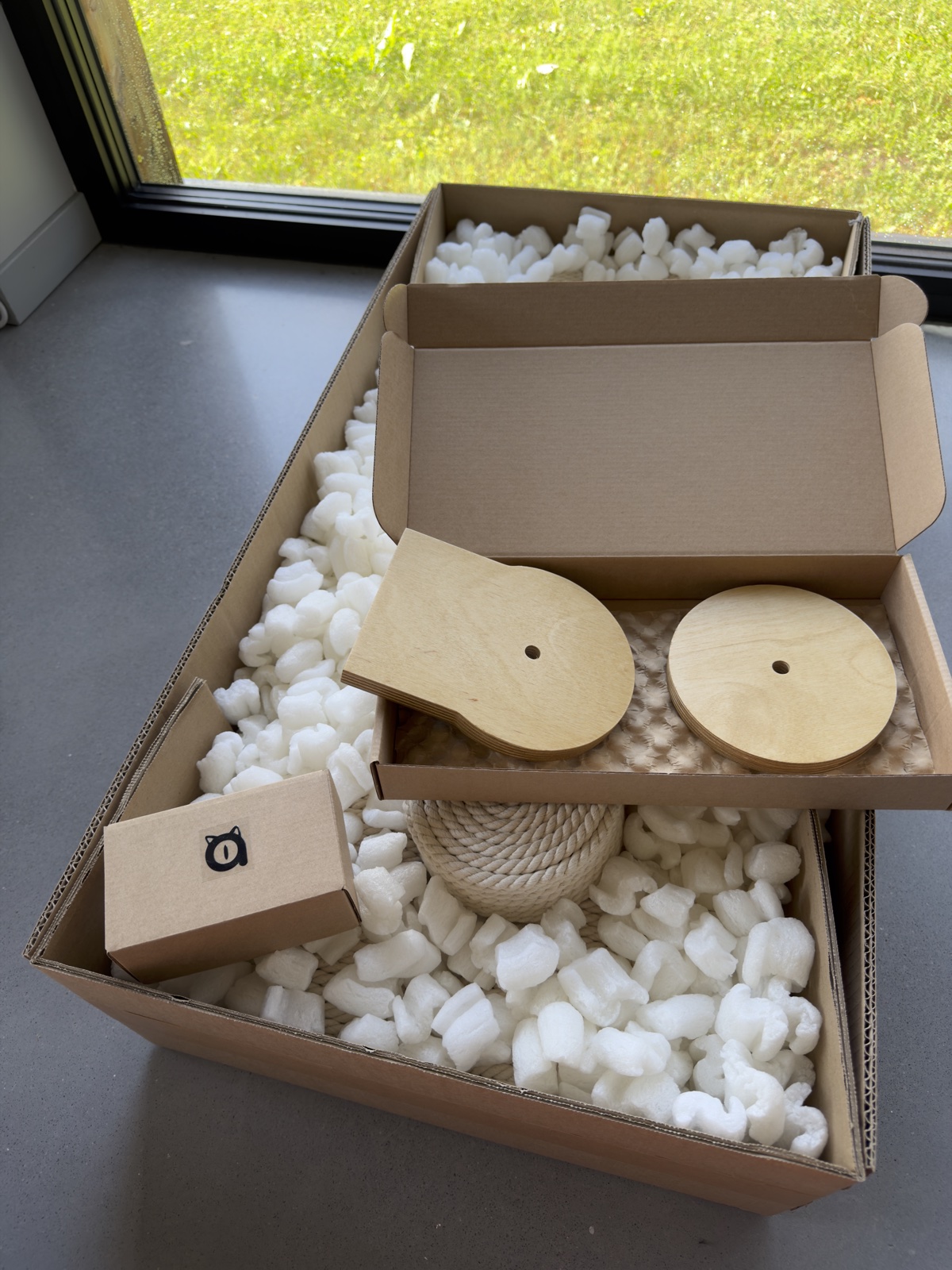
Full instructions are on our assembly page. If you are not confident drilling into your wall, a local handyman can usually fit a wall tree in a short visit.
A wall tree is easy to keep clean because there is no base for dust and fur to collect around. Vacuum the rope from time to time, and use a pet hair remover on faux fur pads. The pads attach with Velcro, so they lift off for washing. The wood is finished with 100% organic wood oil, and a dry or slightly damp cloth is usually all it needs.
Every few months, check that the mounts still sit flat against the wall and the post screws are tight. Look at the rope where your cat scratches most: when it wears through, replace that post and keep everything else.
Every Kikska part fits every other. Add a post to make the column taller, replace a worn post without touching the rest, or move the posts onto a base later and turn your wall tree into a standing one. Posts are solid wood, 13 cm across, in sisal or cotton rope; wood parts come in six oiled colours.
The six wood colours are Natural, Honey, Grey, White, Choco and Brown, so a wall tree can match a floor, a door frame or the rest of your furniture. Spare posts and other pieces are in parts, and you can read more about why this matters in modular cat trees with replaceable parts.
Yes, with the right fixings. Plasterboard needs cavity fixings or, better, a stud behind it. Brick and concrete hold well with ordinary plugs.
In the configurator's wall mode you can stack up to three 80 cm posts, starting about 20 cm above the floor.
Yes. The same posts fit a base, so you can move them off the wall if you move house or your needs change.
Kikska parts have a one-year warranty against manufacturing defects, and items damaged in transit are replaced free.
Comparing options? Read standing, wall-mounted or hanging: which fits your home.
Modular cat tree kits from 84 to 215 cm. Every part fits every other part, so the tree can grow with your cat.

Made in Europe from modular, replaceable parts. Add a level, swap a cushion, change the layout: the tree you buy today keeps working for years.
Worldwide delivery
Shipped with UPS, DHL and FedEx.
Money-back guarantee
Not right for your cat? You get your money back.
Secure checkout
Pay safely with Stripe, PayPal or Apple Pay.
Replaceable parts
Every part can be swapped or reordered.

Modular cat trees, made in Europe and delivered worldwide.
.png)