Guides
Single post, side perch, low and wide or floor to ceiling: how to plan a cat tree layout around your cats, your room and the way cats really climb.
A cat tree is not one object but a layout: where the posts stand, how high the platforms sit, and where a cat can rest, hide or look out. Get the layout right and the tree becomes the favourite spot in the house, the place your cat goes to nap, to watch the street and to burn off energy in the evening. Get it wrong and it turns into an expensive scratching post that nobody climbs.
The good news is that a good layout follows a few simple rules, and with a modular tree you can always change your mind later. Here is how to plan a configuration that suits your cats, your room and the way cats really move.
Almost every cat uses a tree for three things. A good layout gives each of them a place:
If a layout covers all three, your cat has a reason to come back to it several times a day. If it only covers one, it tends to be ignored once the novelty wears off.
Everything stands on the base, so choose it first. The base decides how tall and how wide the tree can safely grow:
All Kikska bases are solid 20 mm plywood with pre-drilled holes, and every hole fits every post, so you can move posts around later without new parts.
When in doubt, go one size up. A wider base gives a tall tree a steadier footing and leaves room to add a second post later. If you plan to hold several platforms out to the side, a broader base also balances the extra reach. Our article on what makes a cat tree sturdy explains why.
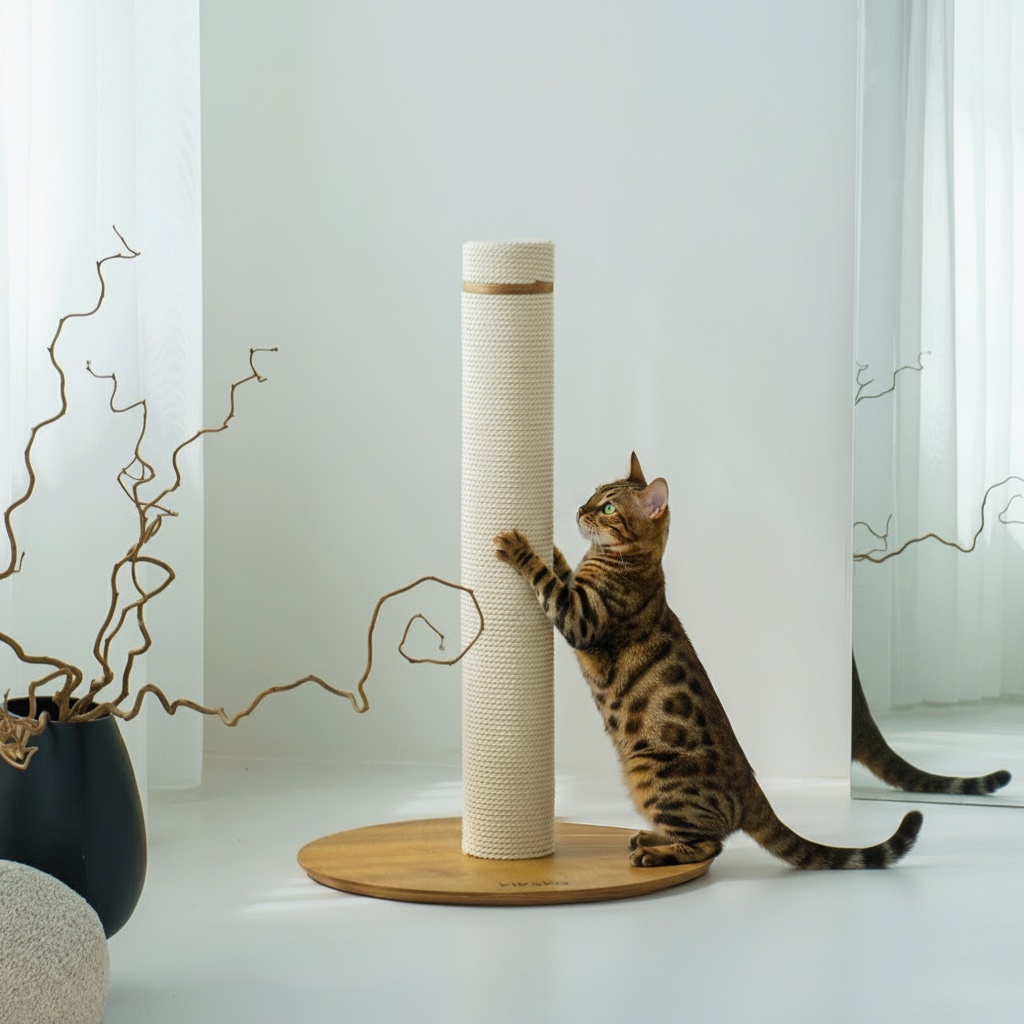
A tall post on a heavy base, nothing else. Ideal next to the sofa a cat already scratches, and the simplest start. Our Simple Scratcher stands 95 cm tall, enough for a full stretch.
One post with a platform on top: scratch at the bottom, watch the room from the top. Compact enough for a small flat, like the 84 cm Mini Meow Tower. Add a fur pad and it becomes a favourite napping spot as well.
A platform held out to the side of a post, so a cat can scratch and settle in the same spot. A platform holder sits on any post and carries a 44 cm platform sideways, as on Petite Perch. Two holders facing opposite ways make a T-shape with a perch on each side.
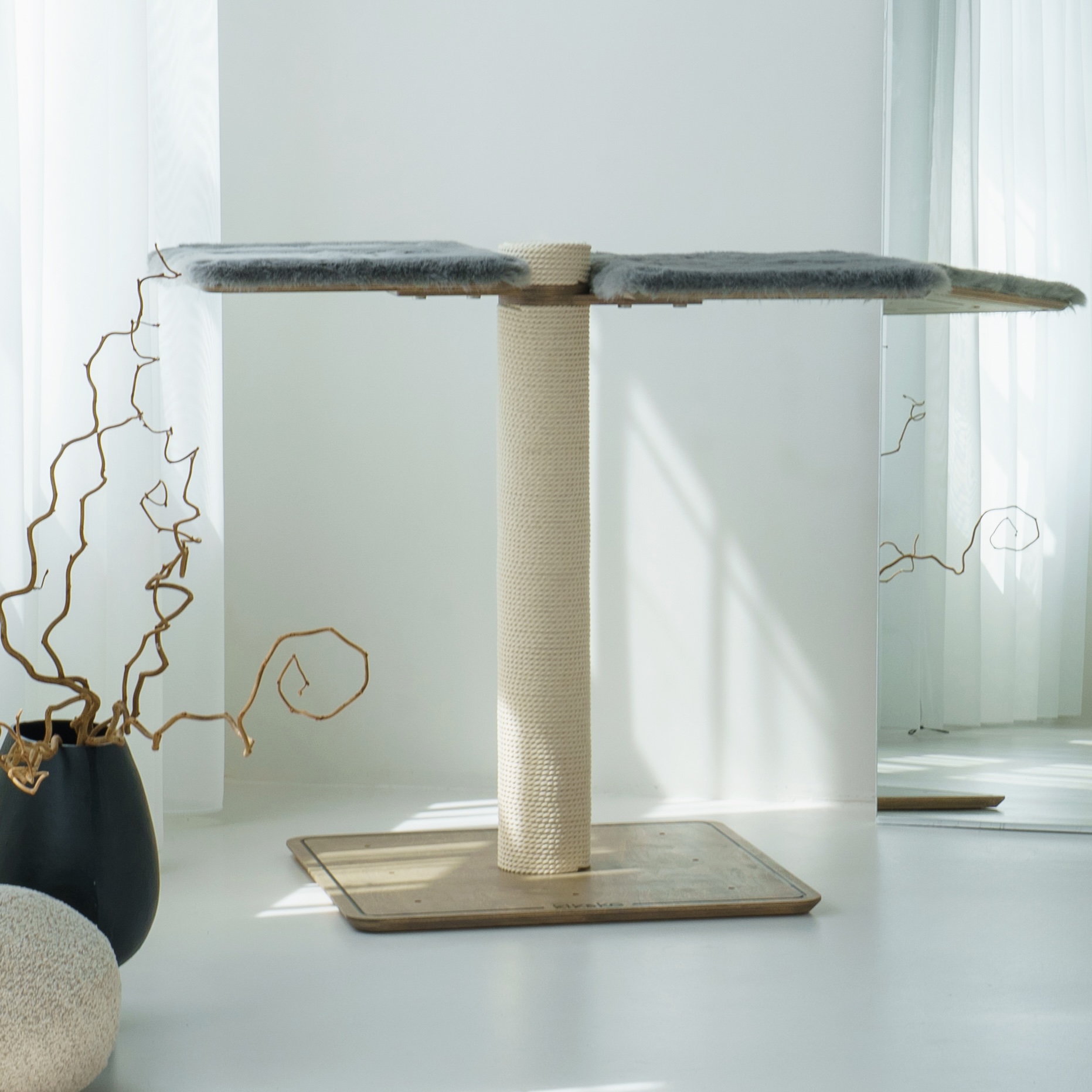
Two platforms at easy jumping height on a broader base. Best for senior cats, kittens and two cats who like to stay close. See Kitty Carnival.
Several levels staggered up to 215 cm, so multiple cats can each claim a height. Leave room above the top platform for a cat to sit up and turn around. Our tallest is Adventurer's Atrium; the Deluxe version adds a wool cave, a hanging toy and a hair remover.
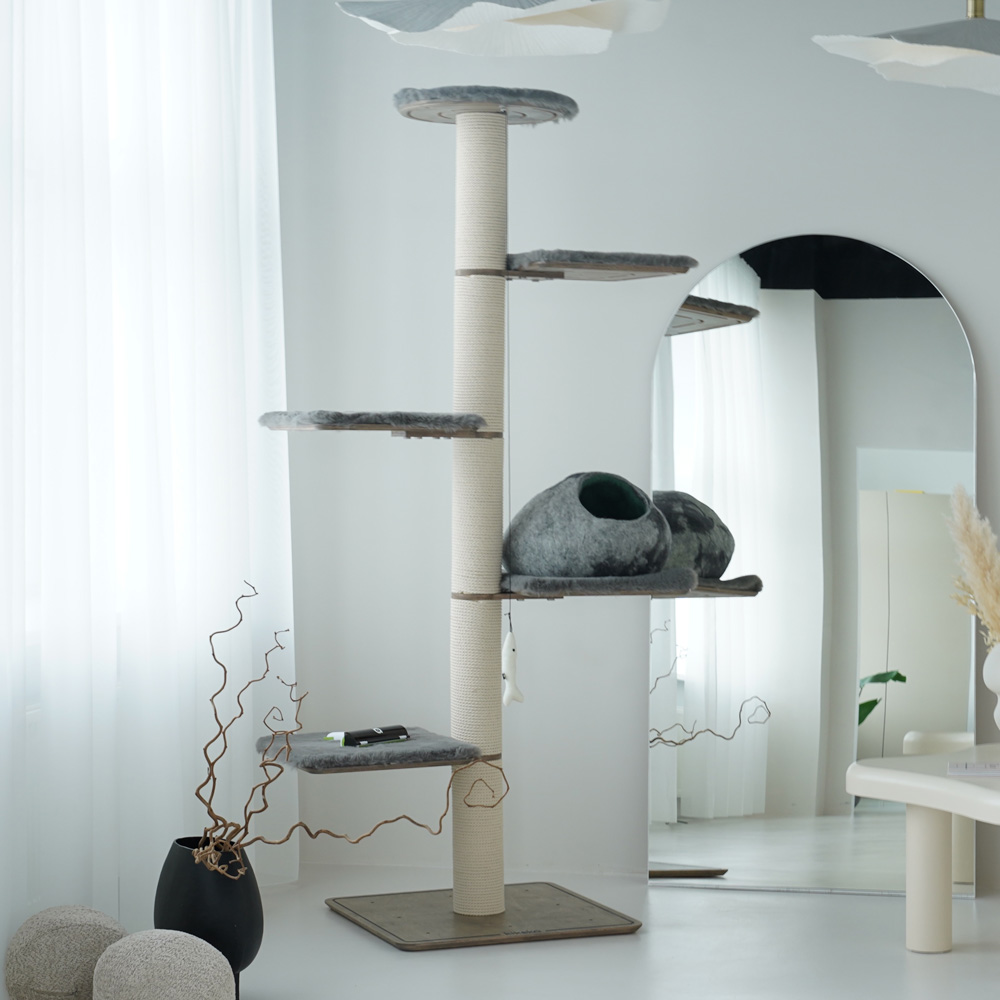

Cats climb by hopping from level to level, not by scaling the post. Keep the gap between one platform and the next to about 40 cm for adult cats, and less for kittens and seniors. Alternate sides as you go up, so each jump is a short diagonal hop rather than a vertical leap. With posts in 20, 40 and 80 cm, you can set each level exactly where you want it.
Young kittens are agile but small, and older cats may find long jumps harder, especially with stiff joints. For both, use shorter gaps between levels: a 20 cm post section between platforms gives a very easy step. Keep the first platform low, add a soft fur pad or a wool cave at an easy height, and build upwards as a kitten grows. For an older cat, a low and wide layout with several resting spots is often more useful than extra height.
Cats share space better when there are more places to be. In a multi-cat home, add platforms at several heights and a hideaway, so a nervous cat has somewhere to retreat that is not the top. A good rule is one resting spot per cat, plus one. Every Kikska tree is built to hold several cats at once, even mid-play.
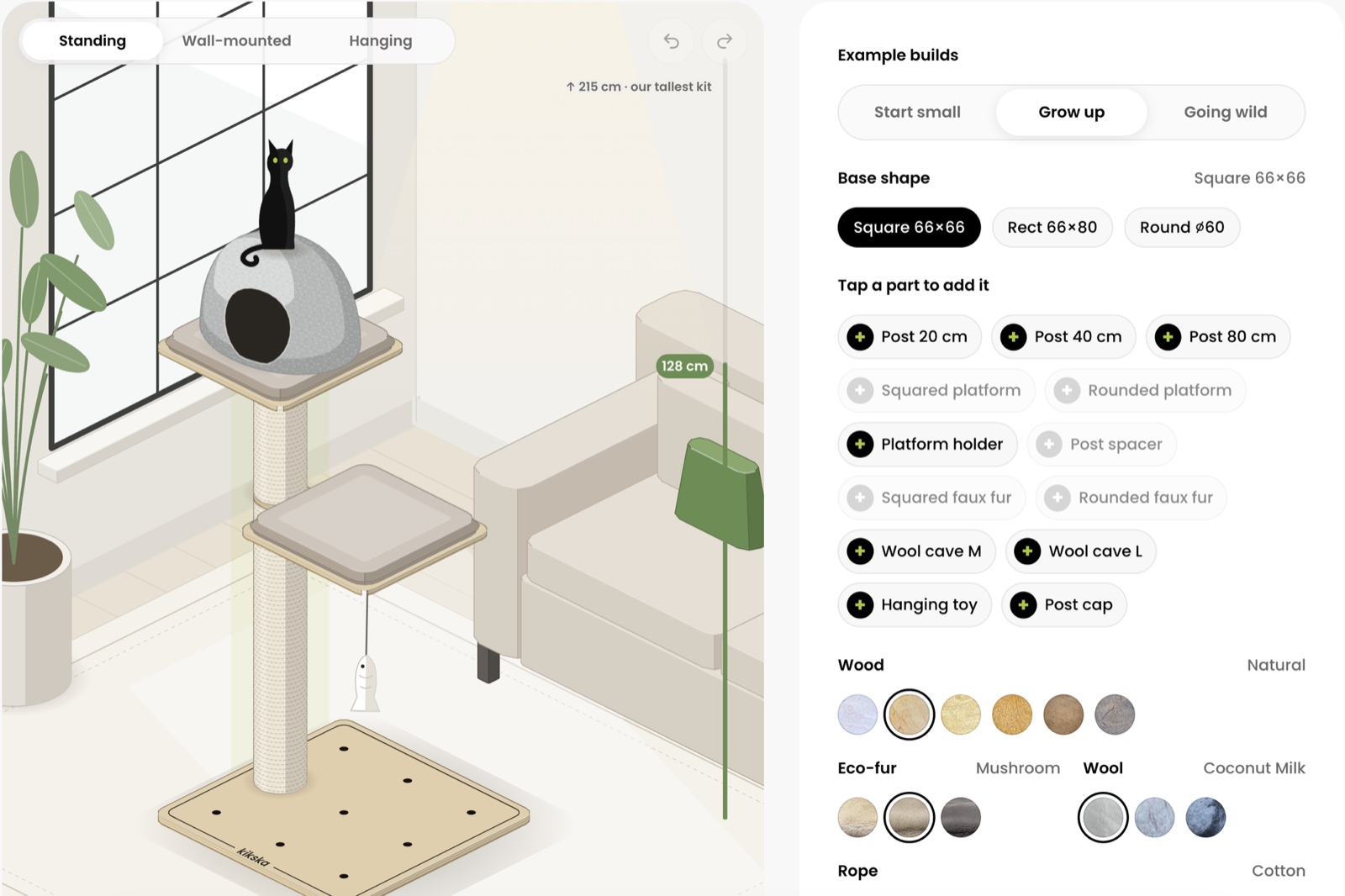
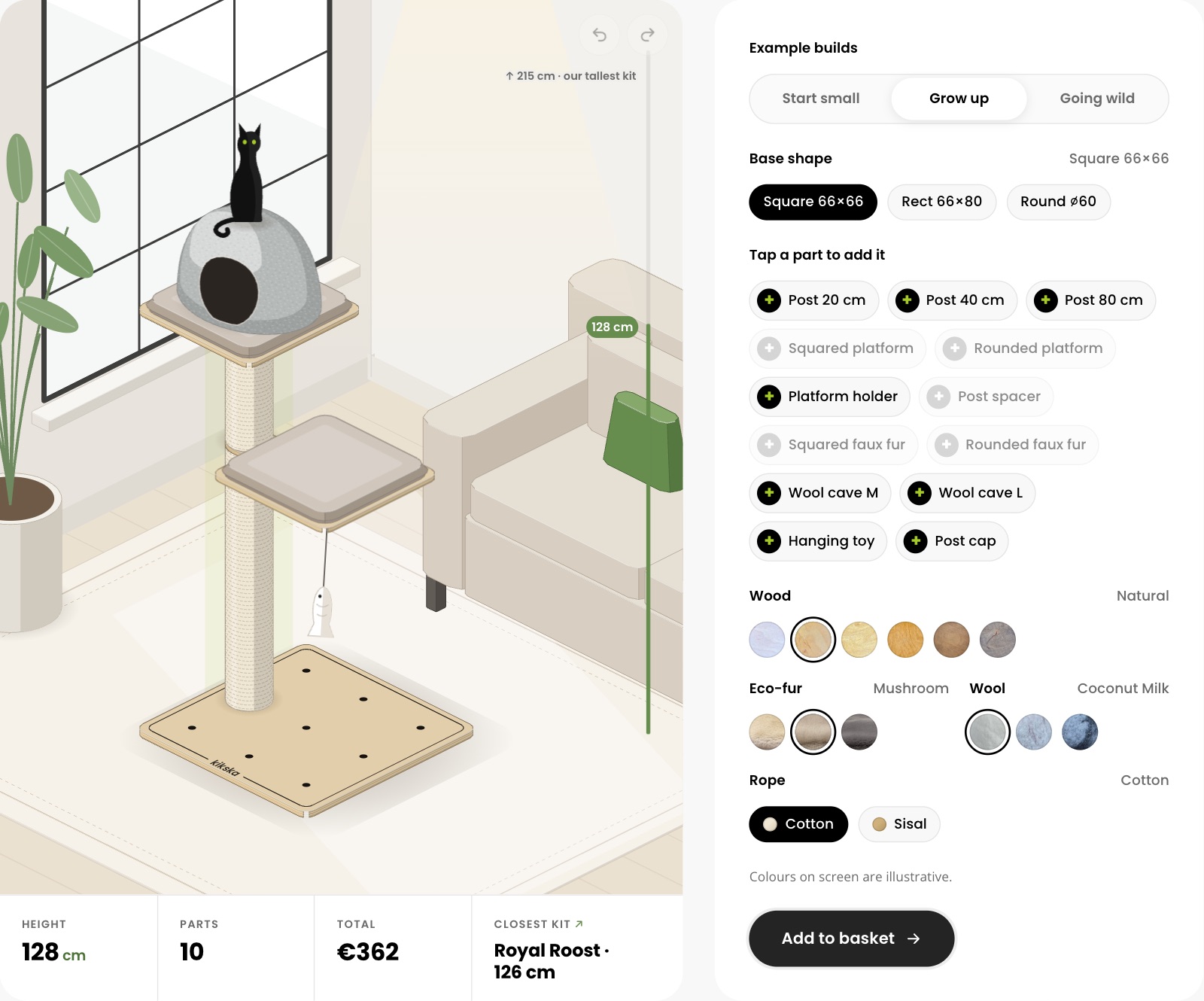
Our cat tree configurator lets you build a tree part by part, the same way you would build it at home:
The tree is drawn to scale in a room next to a sofa and a window, with a height meter beside it, and the parts list underneath updates as you build. When it looks right, add the whole tree to your basket in one go.
It depends on your cat, your room and how many cats you have. A single post of around 95 cm gives a full stretch, while multi-level trees for active or multi-cat homes can reach 215 cm. Measure the ceiling first and leave headroom above the top.
Yes. Posts, platforms, holders and soft parts are all sold separately and fit together, so you can add, remove or move parts. Assembly instructions are on our assembly page.
Because every part fits every other part, you can change the configuration whenever your cat does. Start low for a kitten and add height later, move a platform to the other side, add a wool cave when your cat starts looking for a hiding place, or add a second post when a new cat arrives. You never need to buy a whole new tree to change the layout: just the parts you want to add. Individual posts, platforms and soft parts are in our parts section, and our guide to modular cat trees with replaceable parts explains how it all fits together.
Ready to start? Design your own tree or browse our ready-made cat tree kits.
Modular cat tree kits from 84 to 215 cm. Every part fits every other part, so the tree can grow with your cat.

Made in Europe from modular, replaceable parts. Add a level, swap a cushion, change the layout: the tree you buy today keeps working for years.
Worldwide delivery
Shipped with UPS, DHL and FedEx.
Money-back guarantee
Not right for your cat? You get your money back.
Secure checkout
Pay safely with Stripe, PayPal or Apple Pay.
Replaceable parts
Every part can be swapped or reordered.

Modular cat trees, made in Europe and delivered worldwide.