Interior
No room for a big cat tree? Cats care about height, not floor space. Six ways to give a cat in a small flat somewhere to climb, scratch and hide.
Cats measure their territory in height as much as in floor area. A cat in a small flat can be perfectly happy if it has somewhere to climb, somewhere to scratch and somewhere to watch the room from above. The good news: none of that needs a huge cat tree in the middle of your living room.
This guide sets out six practical ways to give an indoor cat more space without giving up yours, followed by placement tips, mistakes to avoid and answers to common questions. Each idea works on its own, and several work well together.
Before choosing furniture, it helps to think about what your cat does in a day. Most indoor cats want the same few things:
You do not need a separate piece of furniture for each. In a small home, the aim is to cover all four with as little floor space as possible.
A wall-mounted scratching post or cat tree uses no floor space at all. It is fixed at the top and bottom, so it is steadier than a freestanding tree of the same height, and it starts above the floor so you can clean underneath. A hallway, the gap beside a wardrobe or the wall behind a door is often enough. Read our guide to wall-mounted cat trees.
The Skyline Solo is a single 95 cm column between two wall mounts, and the Skyline Scratchers joins two posts into a 190 cm climb. Each wall mount is only 13 x 16.5 cm, so the whole tree takes up little more than the width of its post. In the configurator's wall mode you can also add platforms that point out from the wall, giving your cat a place to sit without anything touching the floor.
Check your wall before you commit: brick and concrete hold well with ordinary plugs, while plasterboard needs cavity fixings or a stud behind it. If you rent and cannot drill, skip to idea 3 or 4.
If there is no free wall, a hanging scratching post hangs on a steel cable from one ceiling fixing, right beside the sofa where your cat scratches anyway. Nothing touches the floor.
The Hanging Solo is 90 cm long and the Hanging Double is 170 cm. Both come with a cable kit: 3 m of stainless steel cable and a ceiling fixing, which must go into a solid ceiling such as concrete or a wooden joist. A hanging post is for scratching and climbing rather than sleeping, so it works best as a second spot alongside a perch or small tree.
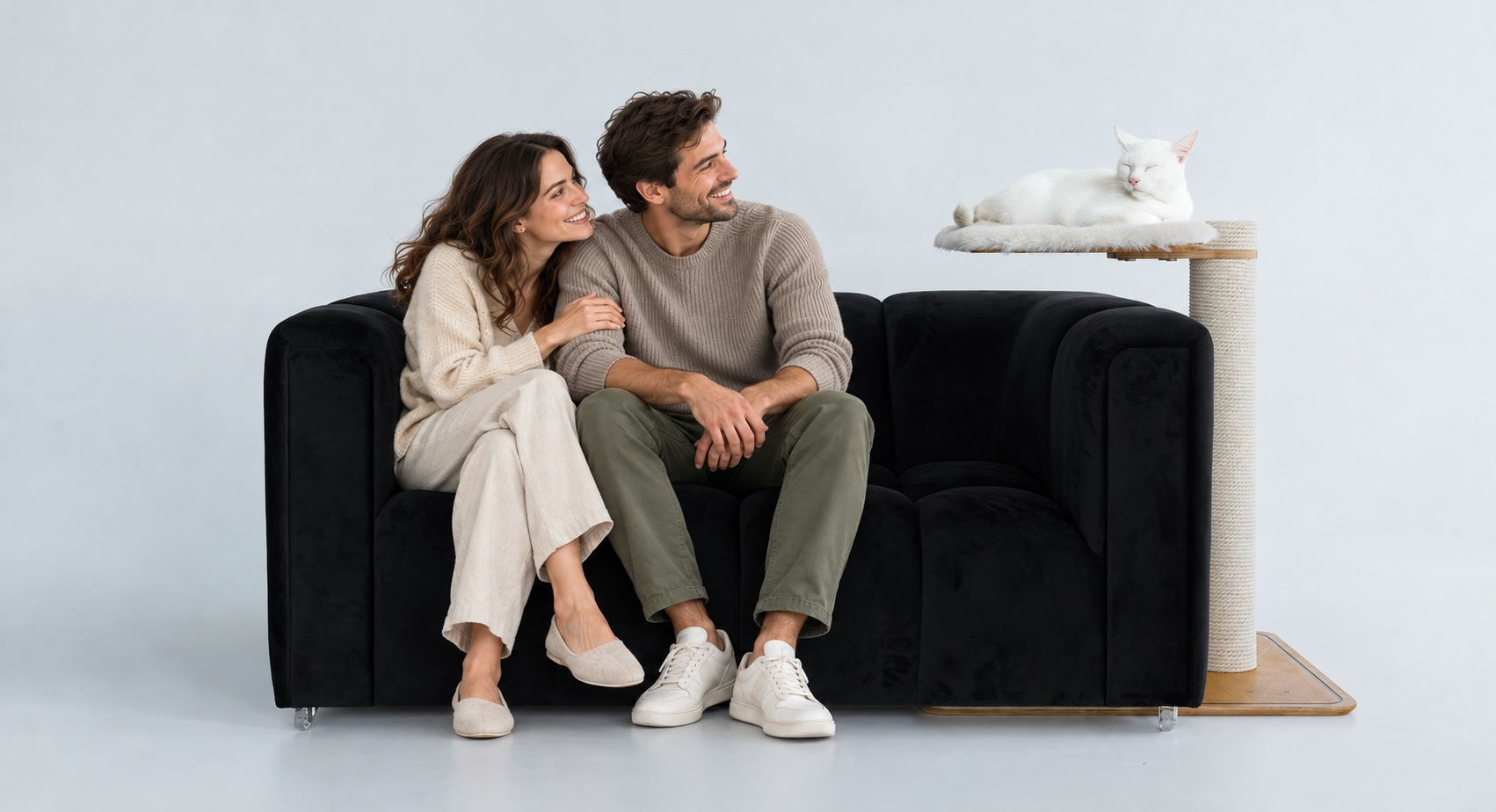
A side perch next to the sofa turns dead space into the best seat in the house: your cat is close to you, high enough to feel safe, and off the cushions. Petite Perch puts a soft 44 cm platform beside a full-height scratching post, 86 cm high.
The gap at the end of a sofa, beside an armchair or between a desk and the wall is usually wasted floor. A perch fills it with something your cat will use every day, and because it sits where you sit, your cat is more likely to choose it over the sofa cushions. Faux fur pads attach with Velcro and lift off for washing, which helps keep fur off the rest of the room.

Height costs very little floor space; width does. A tree with a small base and stacked levels gives a cat more to do than a low, wide one. Our Mini Meow Tower is 84 cm high on a 60 × 60 cm footprint, and Lounge Companion Deluxe reaches 130 cm on 66 × 66 cm, with a wool cave included.
When you compare trees, look at the size of the base first and the height second. A round 60 cm base is the smallest Kikska option, and square bases run from 66 x 66 cm up to 80 x 80 cm. All bases are solid 20 mm plywood, and the 80 × 80 cm base weighs 9.2 kg, which keeps a taller tree planted. For help choosing how tall to go, read how to choose cat tree height, and for what keeps a tree steady, see what makes a cat tree sturdy.
In a small home every object should earn its place. A scratching post that is also a lookout, or a platform with a wool cave on top, gives your cat a bed, a hideaway and a scratching spot in one footprint. A 95 cm scratching post on a 60 cm round base is often all a single adult cat needs next to the sofa.

Hand-felted wool caves are made from 100% New Zealand wool and come in medium and large sizes. Set on a platform, a cave gives a shy cat somewhere to hide that is off the floor and out of the way, without adding a separate cat bed to the room. Deluxe kits include a wool cave, a hanging toy and a pet hair remover, so one purchase covers several needs.
Small flats change: you move, the cat gets older, a second cat arrives. A modular tree lets you start small and add a level, swap a worn post or turn a standing tree into a wall-mounted one later, without throwing anything away. Every Kikska part fits every other, and the configurator shows any combination to scale in a room before you order.

Posts come in 20, 40 and 80 cm lengths and join end to end, so a tree can grow a level at a time. Spare posts, platforms and bases are in parts. Read more in modular cat trees with replaceable parts.
In a studio or one-bedroom flat, the living area is usually the right room. A cat tree tucked into a spare corner of a bedroom tends to be ignored during the day.
In a small flat, a cat tree is always in view, so it is worth choosing one that suits the rest of your furniture. Wood parts come in Natural, Honey, Grey, White, Choco and Brown, finished with organic wood oil, and pads come in Coconut Milk, Mushroom and Cool Grey. For more ideas, read modern cat tree interior design.
The smallest Kikska base is a 60 cm round base. The Mini Meow Tower stands on a 60 x 60 cm footprint.
It saves the most floor space, but it needs drilling. If you cannot fix anything to the wall, a compact standing tree is the practical alternative. Our comparison of standing, wall-mounted and hanging cat trees explains the trade-offs.
Yes. Start with a single post or a small kit from our cat tree kits, then add posts and platforms as your cat or your home changes.
Modular cat tree kits from 84 to 215 cm. Every part fits every other part, so the tree can grow with your cat.

Made in Europe from modular, replaceable parts. Add a level, swap a cushion, change the layout: the tree you buy today keeps working for years.
Worldwide delivery
Shipped with UPS, DHL and FedEx.
Money-back guarantee
Not right for your cat? You get your money back.
Secure checkout
Pay safely with Stripe, PayPal or Apple Pay.
Replaceable parts
Every part can be swapped or reordered.

Modular cat trees, made in Europe and delivered worldwide.
.png)